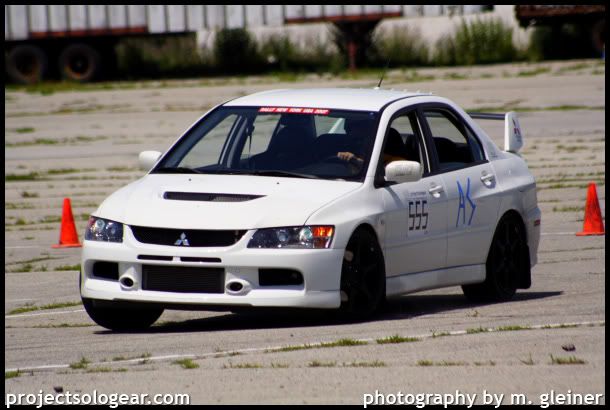
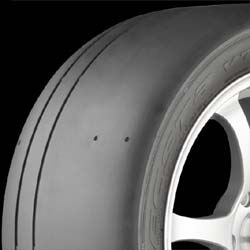
If my memory was as good as 10 years ago, I would be able to tell you how many autocrosses I have ran on these V710, but unfortunately my memory is shot. I would say that these tires probably had a good 6 events on them (I'm counting all of the trophies I have sitting in front of my right now)
No they have not corded, and the surprising thing is I don't have severe camber wear across the thread either. The rubber is a bit beat-up and the wear indicators are starting to disappear though, but it's still got plenty to go until the end of the season!
I've been warned that the V710's are good for the first half of the season, and as the top layer of the material is being worn away, the gripping capability dramatically decreases and it gets greasy easily. In my opinion, cornering on these tires still feels like the car rides on rails, but the turn-in is not as crisp.
I want to share some of the lessons I've learned on my first season racing on R-Compounds!
First, I've been told that the best way to drive the Evo is to pretend that I'm driving a FWD car. In a way it does make sense because the car tends to understeer under hard turn-ins and if the line isn't setup right it will plow the entire turn even with the ACD set at Tarmac! Naturally, the only thing I can play with on the car is tire pressure (the rest of the car is stock) so to dial out understeering I would start the Front at 34psi and Rear at 36psi. At the end of the day I usually end with Front at 33psi and Rear at 37psi. As the season progressed, I realized that this is all wrong.
Although the added oversteering capability helped the turn-in and allowed me to exercise better throttle oversteering on the "out," the ill effects are I had a horrible time keeping the tail in check going through slaloms, on long sweeps I would get unexpected oversteer on the lightest tapping on the brakes (shifting weights to the front), and on trail-braking the car gets skirmish. Worst of all, the tires promoted a driving style that wasted a lot of valuable rubber due to sliding. Many of you know, sliding may look cool but it certainly doesn't give you the fastest time around the track. Plus, R-Compounds are MAD$$$ If they get corded I don't think I have the funds to buy another set this season.
So! There's a lesson learned here. For the past couple of events I started the tire pressure 35psi across the board and kept the pressures around that point. Many experienced racers will agree that the sweet spot for the V710's is at 35psi! One tip you should also remember is on hot days the front tires (due to its double duty of driving and steering) heats up more than the rear. I would lower the front to 33psi and the rear to 34psi. At the end of the run, I will get a pretty even 36F-36R psi distribution.
By doing so, the car became very neutral in handling and had none of the tail snapping action. You would ask, "how about the understeering problem it has?" Yes it still has that problem, and I have learned a few tricks to eliminate it as much as possible. Try these:
1) Do all the braking in straight line, and don't enter the turn too aggressively
2) Late Apex and get on the gas early (you can basically get on the gas as soon as you see the next gate)
3) Experienced drivers would use left foot braking. I have so far no success at it yet...
So, expect more insight to come! Let's hope these tires are good until the end of the season!